The BC Centre for Disease Control (BCCDC) has published a public health risk assessment for the FIFA World Cup 2026™ that determined many health hazards are low risk. However, there are five areas of medium risk that provincial public health will monitor more closely.
“Large sporting events don’t generally lead to substantial increases in communicable diseases or major public health concerns, but they can still pose risks to population health,” said Dr. Jennifer Vines, medical director with the BCCDC public health response team that led the work on the risk assessment.
“We used the risk assessment to consider the probability and impact of various hazards like the spread of communicable diseases, injuries, heat, and alcohol and substance use.”
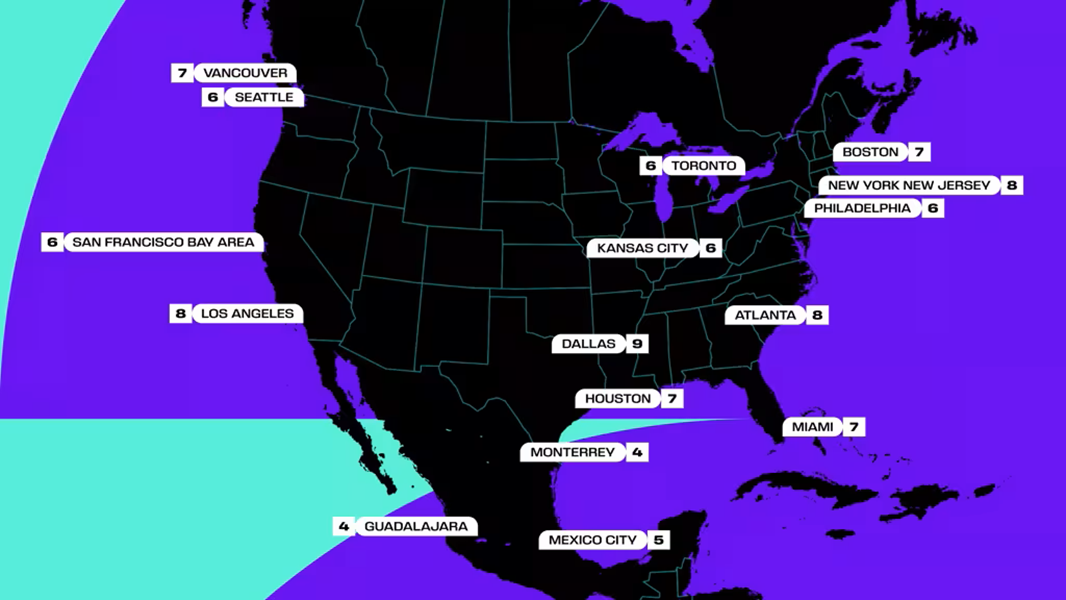 Map of host cities. Source: FIFA
Approximately 350,000 fans are expected to attend seven soccer matches at BC Place Vancouver and thousands of others are expected to attend the FIFA Fan Festival™ Vancouver June 11 through July 19. Hosted in British Columbia by the City of Vancouver, in partnership with xʷməθkʷəy̓əm (Musqueam Indian Band), Sḵwx̱wú7mesh Úxwumixw (Squamish Nation), and səlilwətaɬ (Tsleil-Waututh Nation), along with the Province, partners have been preparing for the influx of people.
The risk assessment examines the health hazards associated with increased population density, close contact in indoor and outdoor venues, higher demands on food services, summer heat, wildfire season, and changes in social behaviour and transportation. Risks are categorized based on a framework that considers the probability of a health event, as well as the health impacts and response capacity of the public health system.
The public health risk assessment highlights five areas with a moderate level of risk:
- Gastrointestinal illnesses associated with food handling and high‑volume food service.
- Respiratory viral infections, including SARS‑CoV‑2 and seasonal influenza that could spread outside of the typical fall and winter respiratory seasons.
- Harms from substance use, including toxic drug overdoses and injuries related to alcohol consumption.
- Heat events.
- Transportation-related injuries related to increased movement of people and transport activity across the city and surrounding areas.
Other risks are assessed as low, as existing public health monitoring systems are expected to be able to respond sufficiently. For example, while it is likely that measles may be introduced during the event due to ongoing measles outbreaks globally, the B.C. health system is poised to take action to limit spread. Tools to respond to measles spread include doing contact tracing when people are exposed to the virus, offering immunizations or immune globulin, and testing.
BCCDC has been working closely with Vancouver Coastal Health and the Office of the Provincial Health Officer to prepare for public health risks associated with large events and increased visitors, all in collaboration with regional, national, and international partners.
“We have used the risk assessment to guide our planning over the last year with the understanding that new health threats can emerge quickly,” said Dr. Vines.
“B.C. has a strong public health system to respond to these new and emerging health concerns.”
BCCDC will monitor public health threats during the event by using existing public health systems and keeping in close touch with partners in B.C. and other host jurisdictions.
Health officials are urging both visitors and residents to take steps to reduce health risks during the event:
-
Practice good hygiene: Clean hands frequently or use hand sanitizer, especially before eating and after being in public spaces or handling shared objects.
-
Stay up to date on vaccines: Ensure routine immunizations — including measles, COVID-19, influenza, meningococcal, tetanus, diphtheria, and varicella (chickenpox) — are current before attending events. Measles is circulating in many countries, and it is respiratory season in the southern hemisphere. For people living in B.C., you can find information on recommended vaccines at
HealthLink BC.
-
Be aware of the drug supply: Visitors should be aware that the drug supply in B.C. is very toxic and unpredictable. Illegal opioids are often contaminated with fentanyl, which is much stronger than other opioids and can be a serious risk of overdose for people who are not used to it. Avoid using substances alone and
call 911 if someone is experiencing an overdose or drug poisoning.
-
Reduce risks when using alcohol and cannabis: Buying and using alcohol and small amounts of cannabis or marijuana is legal for adults 19 years and older in Canada. For people who are new or infrequent users of cannabis, try to choose products with lower tetrahydrocannabinol (THC) and start with smaller amounts. Be aware that it is illegal to transport cannabis outside of Canada. Alcohol and other drugs can put your health and safety at risk and lead to injury, motor vehicle accidents, or cause you to do things you wouldn't normally do. If you’re drinking, drink slowly, consume lots of water and eat before drinking. Never drive after using cannabis or alcohol.
-
Stay cool and sun safe: When outdoors, stay in the shade, use sunscreen and wear clothing, a hat and sunglasses that protect you from the sun. Drink lots of water when it’s hot out, even if you don't feel thirsty. Follow Environment and Climate Change Canada and regional health authorities for information about environmental hazards. In the event of a heat warning, cities and municipalities will open air-conditioned spaces called cooling centres where everyone is welcome.
-
Practice safer sex: If you're having sex, talk to your partner(s) about consent, safer sex, sexual activities or preferences, and testing for sexually transmitted infections (STIs). You can use protection like condoms or barriers to help prevent STIs. If you engage in sexual activity and have new or casual partners, get tested for STIs regularly.