Dr. Sarah Henderson has studied the impacts of climate change for decades, watching wildfire seasons in BC become increasingly severe. The scientific director of Environmental Health at the BC Centre for Disease Control (BCCDC) and professor at the University of British Columbia (UBC) School of Population and Public Health knows how devastating the losses are for First Nations communities, agricultural producers, farmers, businesses, and all who have lost their homes, livelihoods, land, livestock and pets.
"The physical and mental health effects of wildfires and wildfire smoke are likely one of the costliest impacts of climate change in British Columbia," says Dr. Henderson
Most people understand the immediate danger posed by an active wildfire. Families know they should have a plan in place if they need to evacuate, and many have grab-and-go bags ready in their vehicles and in their homes. But when it comes to wildfire smoke and poor air quality, people often seem less concerned.
A common misconception about wildfire smoke is that it's more of a nuisance than a serious health threat," says Dr. Henderson. "However, we have growing evidence that long-term exposure to wildfire smoke is associated with an increased risk of developing many different chronic diseases."
The Environmental Health Services team at BCCDC has been studying health outcomes of long-term exposure to wildfire smoke alongside their peers across North America and around the world. They are comparing year-over-year exposure to poor air quality with new cases of multiple diseases in large populations. Several quality studies published over the past few years show a strong relationship between repeated exposure to the fine particulates in wildfire smoke (PM2.5) and the development of health conditions such as dementia, ischemic stroke, heart failure, and cancer. The growing research highlights the importance of broadening public understanding of how wildfires and wildfire smoke can affect our health. It also emphasizes the need to develop new strategies to ensure better indoor air quality and protect people who work outside.
The health impacts of wildfire smoke also have a big effect on the economy. “Students struggle in school on smoky days, and people are less productive at work," notes Dr. Henderson. “This is partially because of the emotional burden and partially because wildfire smoke directly affects the brain."
A recent study in the United States estimated the economic impacts of short- and long-term deaths due to wildfire smoke exposure “exceed existing estimates of climate-driven damages from all other causes combined in the US," and suggested that the health impacts could be among “the most important and costly consequences of a warming climate."
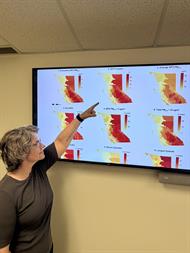
What does this mean for people living in BC? “It's critical that we all be mindful of air quality during wildfire season and take action to reduce exposure to wildfire smoke when the Air Quality Health Index (AQHI) shows moderate risk or higher," says Dr. Henderson.
Dr. Sarah Henderson points to a visualization of widlfire smoke PM2.5 levels throughout BC from 2010 to 2023, part of study published in April.
There are a few things people can do to protect themselves, including monitoring the air quality in your area, focusing on cleaner indoor air when AQHI levels are moderate or higher (4-10+), and taking it easy or wearing respiratory protection when you must go outside during smoky conditions.
In addition to the physical health impacts of wildfires and smoke, Dr. Henderson says we need to acknowledge the huge emotional and mental health consequences for people who are displaced and who are faced with weeks of poor air quality. Wildfire damage to the land, water, air, and communities is deeply distressing. Posting photos and stories on ecolens.ca is one way to share your experiences and build a sense of connection among people across BC.
“We MUST listen to First Nations and learn from traditional practices when it comes to wildfire prevention and management," concludes Dr. Henderson, noting that cultural burning has long been used to support the land and reduce wildfire risk.
"We need to start considering how to protect our communities from wildfires and wildfire smoke for the generations to come."