BC Provincial Overdose Cohort (BC-ODC)

The Provincial Overdose Cohort is a population-level cohort of all people who accessed health care during a drug poisoning event or who died of drug poisoning in British Columbia (BC), Canada

​​​​​​People represented in the BC Provincial Overdose Cohort (BC-ODC)

The BC-ODC represents people who were identified as having a drug poisoning event (i.e. overdose) and have linked demographic data available in BC's administrative health datasets.

The BC-ODC is updated annually. Currently, the BC-ODC contains 66,229 people who experienced a drug poisoning event between January 1, 2015 and December 31, 2023* ​

  • One quarter (N=16,271) of people experienced a fatal drug poisoning and three quarters (N=49,958) experienced a non-fatal drug poisoning.
  • 67.7% of people who experienced a drug poisoning event were male 
  • 47% of people who experience a drug poisoning event were 19-39 years of age.
    • People in this age group comprise 31% of the BC population.
 ​*The BC-ODC undercounts non-fatal drug poisoning events, as we cannot capture events that happen in the community, with no contact with health care. ​


Data sources

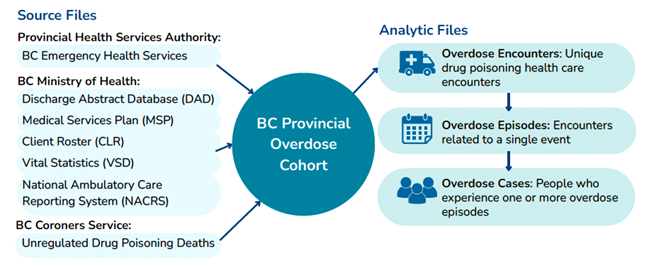
The BC-ODC is a set of administrative data linked at the patient level. People who experienced a drug poisoning event were identified through the source files listed below. 

Source Files​

Provincial Health Services Authority:

  • ​BC Emergency Health Services​

BC Ministry of Health

  • Discharge Abstract Database (DAD)
  • Medical Services Plan (MSP)
  • Client Roster (CLR)
  • Vital Statistics (VSD)
  • National Ambulatory Care Reporting System (NACRS)

BC Coroners Service

  • Unregulated Drug Poisoning Deaths

Data are then translated into analytic files to represent drug poisoning events. A drug poisoning event is any fatal or non-fatal drug poisoning event. Drug poisoning event data is available in the BC- ODC at three different levels: ​

Drug poisoning event data in the BC-ODC

Drug poisoning encounters. An encounter is defined as a grouping of health care or death records that occur within a short period of time. Encounters are constructed separately within each source dataset, and each encounter is associated with a corresponding 'source' variable indicating its origin. An encounter is classified as a drug poisoning encounter if it includes at least one record related to a non-fatal or fatal drug poisoning.

Drug poisoning episodes. An episode is a grouping of encounters in which no more than 24 hours elapse between any two consecutive encounters.  For an episode to be classified as a drug poisoning episode, it must include at least one drug poisoning encounter.

Drug poisoning cases. Cases are people who have had at least one non-fatal or fatal drug poisoning episode

Figure 1: BC-ODC Source Files and Analytic Files

BC-ODC Figure 1.png

Access, uses, and limitations of the BC-ODC

How do I access the BC-ODC?

The BC-ODC is available as a dataset in the PHSA PANDA platform and will be available in the Ministry of Health's Health Data Platform in 2026.

PHSA affiliated teams can access the BC-ODC in PANDA, while government analysts and academic researchers can request access to the BC-ODC in the Ministry of Health's Health Data Platform.

https://healthdataplatformbc.ca​

Uses and limitations:

The BC-ODC is not a surveillance tool. It does not have real-time information on drug poisoning events. For up-to-date surveillance reports, see the Unregulated Drug Poisoning Emergency Dashboard.

The BC-ODC includes administrative data, this is information collected routinely by public and government organisations. As a result, some research questions cannot be answered with this data. For example, we cannot look at drug poisoning events where health care was not obtained. Some people who experience a drug poisoning and do not have a health card or personal health number, cannot be identified in this data.​ Thus, it does not include all drug poisoning events in the province.

Publications & Reports

Research Outputs of the BC Provincial Overdose Cohort

The BC Provincial Overdose Cohort (BC-ODC) is a collection of information on people who had a drug poisoning event (i.e., overdose). The BC-ODC is focused on using data for action to prevent overdose-related harms and deaths. It has been used to support many research projects and the findings of these projects are shared on this page.

Analyses with the BC-ODC have been guided by a prioritization exercise co-led by partners, including people with lived or living experience of substance use and overdose. The outputs of research on the BC-ODC are shared below, organized by priority alignment area.

Click on the name of the study to access the publication online.​

Prescribing Patterns


People & Populations and other ODC Research Outputs


​​​​​​


Tab Heading